For a long time, everyone loved SoundCloud, including many of the world’s most influential DJs. The love affair DJs had with SoundCloud is on the rocks now that SoundCloud has implemented the integration of Audible Magic’s SmartID and CopySense® technology into the service, which will help the company protect copyright owners from infringement. DJs? Well, they’re starting to feel the pinch and its leaving a sour taste in their mouths, while also forcing them to divorce themselves from SoundCloud and post their DJ mixes elsewhere.
http://twitter.com/Mathias301/status/270593471281233920
The Mix Tape
Ever since the advent of the DJ, there’s been the recorded “mix tape,” which – depending on who’s definition you get – is also called a “dj mix,” “dj set,” or “mix show.” The latter is generally used to describe a live or pre-recorded mix broadcast in a pre-defined time slot on terrestrial, satellite and Internet radio. DJs have passed around their mix tapes using many differing recorded formats, including vinyl, reel to reel, cassette, 8-track, mini-disc (MD), digital audio tape (DAT) and compact disc (CD). Many DJs today strictly distribute their mixes as MP3 or FLAC digital audio files. Purists will even go far as to share uncompressed .WAV or .AIFF digital audio files.
SoundCloud, like its video-oriented cousin, YouTube, allows the owner of a sound recording to upload audio content to its website, where it can then be streamed using a highly customized audio player experience that allows for user-generated comments along the audio timeline – in essence, making the audio track “social.” By simply adding the a SoundCloud URL to a Facebook status update, a SoundCloud audio player “widget” can be published into a Facebook status update, or special code provided by SoundCloud will allow the audio player widget to be embedded in a blog post or webpage. Listeners can comment at points on the audio timeline, favorite tracks to their SoundCloud profiles and Tweet or re-share them into their own Facebook profiles.
Below is an example of a SoundCloud embeddable widget for the Kaskade vs. Albin Myer‘s track, “Don’t Stop Hells Bells.”
In the early pre-MP3 days of the Internet, many DJs used Real Networks RealAudio®, Microsoft’s WindowsMedia® or Apple’s QuickTime® technology to stream their mix shows, but in each case, the cost of maintaining the streaming technology was prohibitively expensive. The implosion of Internet services in the Dotcom 1.0 era (roughly 2000 to 2004) made it difficult for independent webcasters to generate ad revenue that would support broadcasting niche formats like underground techno DJs mixes. A DJ needed a contract with an Internet Service Provider (ISP) that operated a streaming server from one of the aforementioned major tech companies.
Not only was accessing a streaming server costly, but ISPs also charge for bandwidth. The more traffic, the higher the cost. In addition to bandwidth fees, new licensing rules were put in place by the passage of the Digital Millenium Copyright Act, which forced many DJ sites to pay public performance royalties to songwriters through ASCAP, BMI and SESAC, as well as to artists through SoundExchange (for non-interactive streaming only). Things were getting way too expensive for the average DJ to be able to afford webcasting and many DJs operating streaming mix show sites, including this site, had to shut their doors or find alternatives while the industry sorted itself out and new technologies arrived to lower costs.
Fortunately, along came webcasting providers like Live365, who bundled the cost of streaming with performance royalty licensing. Live365 negotiated direct deals with the PROs on behalf of their account holders, so that would take the onus off of the DJ to report daily spins of music over webcasts.
But, Live365 was just that – live! Not every DJ can program a 24-hour a day radio station. That’s when many Internet radio DJs turned to open source webcasting tools like ShoutCast and IceCast, which provided free webcasting software that could be installed and run on an ISP’s server or even your own computer acting as a server (Macs can easily do this), while using your cable provider as an ISP. Of course, today, many cable providers are throttling bandwidth, making hosting your own webcasting server a problem.
MP3s Change the Game
The mass adoption of the MP3 format was a game changer. Not only could a DJ stream their mixes without having to use streaming server technology, but they could also provide mixes in podcast format. On a parallel track, as more people migrated to MP3, blogging technology like Movable Type and WordPress gave DJs the ability to post their mixes to their blogs utilizing enclosures and open source, javascript audio players. DJs could then feature mixes that listeners could subscribe to and receive notifications from their blogs when new mixes were posted. While podcasting is still a fantastic way to broadcast DJ mixes, there was still the sticky issue of paying rights holders. There may be podcasting aggregators who, like Live365, offer PRO services.
That’s just about when SoundCloud came along. We can’t say for absolute certain that the founders of SoundCloud created the service for DJ mixes or as a service for artists and labels to post single tracks, but once DJs learned they could post their mixes to the SoundCloud system, many started gravitating to the service for a few reasons.
First, uploading to SoundCloud and having your mix playback immediately in a unique player experience, which could then be embedded into blogs and social networks took the onus off of the DJ to have to support their own website and podcasts. Second, SoundCloud’s social timeline, where users comment along the audio timeline, was an innovation that is simply not available to DJs using open source audio players for their podcasts. Lastly, DJs could upload and control their mix in block formats and then shares those mixes exactly as intended – in the mix-tape format. No longer did DJs have to maintain live feeds or submit to other Internet radio stations and wait to hear their mix. They could provide their mixes direct to fan in a matter of seconds, disrupting the entire underground DJ mix market, which had thrived for years in “mom and pop” record shops, which would sell those illegal mixes from behind the counter.
DJs, Infringement and PROs
Thousands of DJs use SoundCloud for their mixes today, but they’re now finding out that the party is over. Before SoundCloud raised over $50M in a round of recent venture capital funding, they were predominantly a European-based service operating in the grey area of performance rights, where the rules may be different than in the USA around paying public performance royalties to the PROs. Honestly, we don’t know what the difference in the rules are, but it always seems like these services start in Europe and once they become large enough where major labels and the RIAA take notice, they quickly have to ensure their in compliance with the DMCA. Since SoundCloud is considered interactive and not non-interactive, the company is not eligible for a compulsory license, so if the site were found to house copyrighted content, it could be sued by the copyright owner. For user-generated content sites like SoundCloud, ensuring their in compliance with the DMCA is now a cost of doing business in the United States.
SoundCloud could exist and still accept DJs mixes if they hadn’t had much grander plans. But something as cool as SoundCloud could operate under the radar only for so long. Once the VCs funded them, it’s safe to say that a pre-condition of that funding was that SoundCloud would have to ensure that the company adhered to the letter of the law as defined by the DMCA and subsequent legislation around paying the PROs performance royalties. They would also have to provide some type of technology to identify infringing content, should copyright owners want to leverage the powers of the DMCA to notify SoundCloud that someone had infringed on their copyright by posting their content to the service without permission. These are the same rules that YouTube or any other UGC (user-generated content) service must adhere to, which is where Audible Magic comes into play.
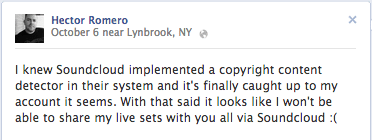 Netmix has learned through conversations with many DJs that SoundCloud’s new Audible Magic technology implementation has been flagging and removing their DJ mixes for infringing content. In fact, there was a massive discussion on DJ, Hector Romero of Def Mix Productions wall, where Romero had posted this happened to him and he wasn’t sure why.
We don’t have screen shots of this process, but in our conversations on Hec’s Facebook wall, through Twitter posts and other discussions, Netmix learned the following:
- DJ creates mix and uploads it to SoundCloud
- SoundCloud’s Audible Magic technology integration identifies the mix as “infringing” and automatically issues a take down notice to the DJ.
- The DJs mix is removed from the site.
- The DJ can appeal the take down.
- If the appeal is successful, the mix wil be restored. If not, the mix will not be restored.
Sounds simple, right? Audible Magic reads the tracks in the DJ mix, recognizing some infringing content and then automatically issues a takedown.
Well, here’s what we found out from a few DJs this has happened to. SoundCloud has to provide a mechanism for the account owner (the DJ) to appeal the take down. We have learned from one DJ that he has appealed a couple of times, even though he doesn’t own the copyright to the songs in the mix. SoundCloud has reinstated the mix, solely based on receiving the appeal. That begets the question: is it really that easy to fool SoundCloud and get them to restore your DJ mix, simply by challenging the takedown notification?
We also found that a few DJs started to see a pattern in Audible Magic’s scanning on their mixes. When the DJs first uploaded their mix and SoundCloud issued a takedown, they tried to fool Audible Magic by removing the first track in their mix. This is possible by either editing out the mix using a free sound editing tool like Audacity, or if you’re a digital DJ and use a digital audio workstation like Ableton Live, you could just remove the first track, re-export your mix and then re-upload it to SoundCloud.
What these DJs found is that by removing the first track, they could easily re-upload their mix and Audible Magic would’t flag the re-upload mix as infringing. How is this possible? We’re thinking it could be Audible Magic’s technology only scans the first few seconds or minutes of the upload to see if the content is infringing and that it doesn’t take snapshots along the mix timeline. While the first few seconds to minutes may have been infringing, once the mix is re-uploaded, we think that Audible Magic doesn’t scan the mix again. It already scanned the first go’round, so why scan a second time? Scanning multiple times take processing power of the servers that run the scan software. It can only scan so many tracks at one time. Since thousands of songs are being uploaded every day, the technology has to run the scans in a cue and each song or a set of songs wait their turn, depending on how many servers are employed by Audible Magic to perform the scans.
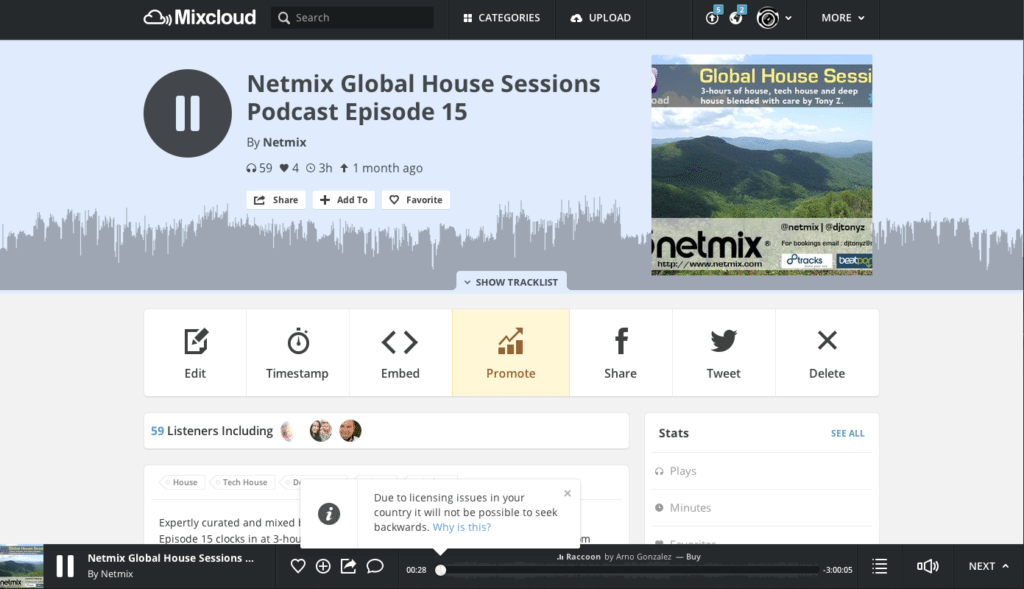
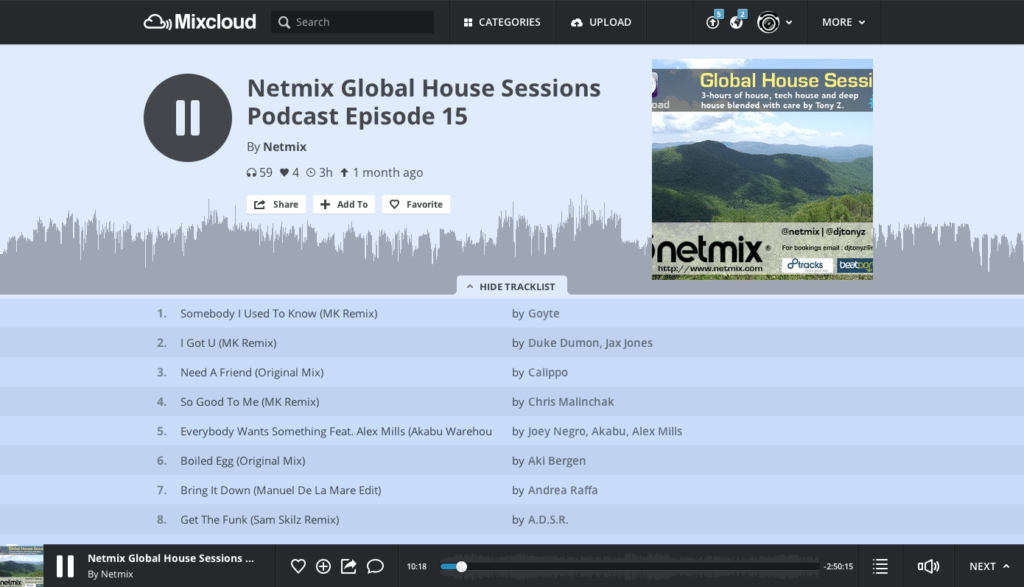
Of course, many DJs are not going to waste their time or energy trying to fool Audible Magic, so they can post their mixes to SoundCloud. What’s a DJ to do? Fortunately, a few competing service have come along. The most popular being MixCloud, which is free to post and is supported not be audio ads, but by users who will pay to ensure that their mix is featured on the site’s home page for a period of page impressions. There’s also a service out of Austria, Play.fm, that we love. They’ve been at it a while and their site and service is top notch.
BTW, Netmix has a MixCloud here: http://www.mixcloud.com/netmix. We hope you’ll follow us and share our mixes with your friends!